
Open a sale catalog and it is easy to do one wrong thing. You run your eye down the page, find the biggest dollar figure, and circle that bull. Bigger has to be better, right?
Not here. The biggest number is the wrong target if it is the wrong index.
A $Value is a dollar index. It takes a whole set of EPDs, weighs each trait by how much it moves money, and reports one number: expected dollars of profit per head. But it does that under one stated way of running cattle. Change the operation and the same bull is worth a different amount. So the real question is not “which number is highest.” It is “which index was built for a man who makes money the way I do.” Get that right and the rest sorts itself out. (For what goes inside one of these indexes, see what’s inside a $Value.)
Start with a plain question. How do you make your money?
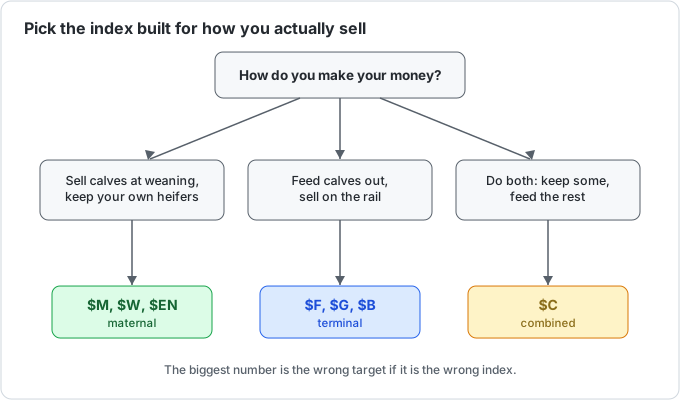
You sell calves at weaning and keep your own heifers
This is the cow-calf man. Your paycheck is the calf at weaning, and next year’s cows come out of this year’s heifers. Three numbers are built for you.
$M, Maternal Weaned Calf Value. This is the cow-herd index. It rewards a moderate cow that breeds back, holds up on her feet and udder, keeps a level head, and still weans a good calf, all without getting bigger and costlier to feed. Pro: it is the one index built around keeping daughters. Watch-out: it assumes you keep replacements, so if you buy all your females, $M was built for somebody else.
$W, Weaned Calf Value. This one covers birth to weaning: pounds of calf on the ground. Pro: it matches the man who gets paid by the pound the day the calves ship. Watch-out: it leans on pounds of weaned calf and puts far less weight on lifetime cow feed cost than $M or $EN do, so it can still let cow size creep up on you.
$EN, Cow Energy Value. This is a savings number. A higher $EN means the cow costs less to feed each year, mostly because she is a bit smaller and milks within reason. Pro: it puts a real dollar on the feed bill, the thing that eats a cow-calf man alive. Watch-out: it is only a cost, not the whole cow. Read it next to $M. Do not chase cheap upkeep so hard that you starve the milk and pounds that pay you.
You keep the calves and sell on the rail
This is the man who owns his calves past weaning, feeds them, and sells on carcass merit. The mother does not matter to your check. Growth and carcass do. Three numbers fit here.
$F, Feedlot Value. Post-weaning merit in the feedyard: gain and feed efficiency. It assumes you own the calf through the feedlot and sell on carcass weight. Pro: it rewards fast, efficient pounds in the pen. Watch-out: it says nothing about the cow, so it is the wrong number if you are keeping daughters.
$G, Grid Value. Carcass grid merit: quality grade and yield grade, the marbling and the cutout. Pro: it pays off when you sell on a grid that actually rewards a better carcass. Watch-out: it only cashes in if your buyer pays that grid. Sell everything at a flat average price and $G is not your number.
$B, Beef Value. The terminal package: feedlot plus carcass in one figure. Pro: one number for the man who weans the whole calf crop, feeds it out, and sells on merit. Watch-out: it is terminal. It assumes you keep no daughters. A bull who tops the $B list can be exactly the wrong bull for a cow-calf man, because none of that carcass value helps a cow raise a calf.
You do both: keep some heifers, feed the rest
Most outfits live here. You hold back your best heifers for cows and feed out the rest.
$C, Combined Value. The broadest index. It pulls in everything in $M and everything in $B. It assumes you replace about a fifth of your cows each year with home-raised heifers and feed out the rest on a quality grid. Pro: for a herd doing both jobs, it is the closest single fit. Watch-out: broadest is not automatically best. If you lean hard one way, a sharper single-purpose index fits you tighter than the one that splits the difference.
The point to carry to the counter
A $Value is two things stacked: a genetic prediction, and a set of price assumptions about one kind of operation. It works only as well as those assumptions fit you. That is why Darrh Bullock, in the University of Kentucky guide to using EPDs, puts it plainly: a well-suited index is the option with the least risk of a poor pick. Not the biggest index. The suited one.
So pick the index that matches how you make money, then read for the biggest number inside that index, not across the whole page. The full definitions live at the American Angus Association, and no breeder computes any of these. The Association runs them breed-wide, every week, and re-prices the assumptions each year. What a breeder does is match the index to his own country and cows.
This is piece 5 of EPDs, Plain and Simple. For the recipe inside a $Value, back up to what’s inside a $Value. For the whole picture behind the numbers, read what EPDs really are.