You are standing at the pen with the sale book open. The bull’s page is in front of you: his EPDs down one column, his dollar indexes down another, an accuracy beside each one. You can read that page now. So here is the honest next question. Once you have read it, what does a careful operation actually do with it?
That is what this piece is about. Not how to read a single number, but how the numbers fit into a Monday morning: what you can trust the Association to have done for you, what you can honestly work out on your own, and where the line sits between the two. The line is the whole point, so let us start there.
The numbers on the page are not yours to make
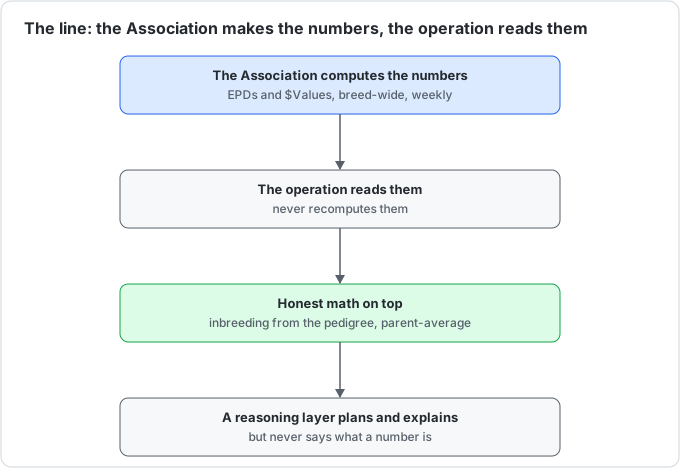
The EPDs and the dollar indexes on that page did not come from the seller, and they did not come from you. They come out of the American Angus Association’s National Cattle Evaluation, run by its genetics arm across the whole breed at once. The evaluation folds pedigree, weigh-day records, and DNA together in one pass, so any one bull’s number carries information from his relatives all over the herd book. It runs every week and releases on Fridays. Genomic tests are built in through what is called a single-step method, which sharpens a young animal’s numbers before he ever sires a calf.
No single breeder can reproduce that, and none should try. You would need the whole breed’s records, not one herd’s. So a careful operation does not compute EPDs. It reads them. Every genetic number it works with is a published value with a date on it, and it treats that value as a fact handed in from outside, not something to re-figure at home.
That is the first half of the line. The Association makes the genetic numbers. You consume them.
What you can honestly work out yourself
The second half is smaller, and it is real. There are a couple of things a single operation can legitimately compute on its own, from a pedigree and from those published values. They are not EPDs. They are honest arithmetic you can check by hand.
The first is inbreeding. Give a pedigree, and you can compute a coefficient of inbreeding, the odds that a planned calf carries two copies of the same ancestral gene through both its sire and its dam. This is a pedigree calculation with a fixed answer. Mate two full sibs and it comes to 0.25 every time. It is genuinely worked out at home, not looked up. It comes with a catch you have to respect: it is only as complete as the pedigree behind it. A shallow pedigree hides common ancestors, so it reports a low number that is too low. An honest tool reports how deep the pedigree went, so a thin number is not mistaken for a clean one. It is also an expectation, not a DNA reading. It tells you what to expect from known ancestry, and stops there. For the longer walk through what that number means, see reading inbreeding coefficients.
The second is planning a mating before it happens. For a pairing you are thinking about, you can estimate each trait in the calf as the average of the sire’s and dam’s published EPDs. Sire at +80 for weaning weight, dam at +60, the planned calf sits at +70. This is the parent average, and it is the one figure in the whole workflow that looks EPD-flavored. Be careful with it. It is an expectation before the fact, not a real EPD. When that calf is born, gets weighed, and enters the Association’s evaluation, its published number will differ from the parent average, because each calf draws its own random half of each parent’s genes, and because its own record then counts. The parent average is good for one job: comparing candidate matings against each other on paper. It is not for pinning a genetic value on any animal.
Both of these lean on the Association’s published numbers as their starting stock. Neither one makes a new genetic number. They arrange the numbers you were given.
Weighting the numbers toward how you make money
There is a third thing a careful operation does, and it is easy to mistake for computing, so read this part slowly.
The Association already publishes dollar indexes that bundle many EPDs by their economic value under a stated goal. $M leans maternal, $B leans terminal, and so on. For most operations one of those fits well enough, and the right move is to pick it. See which dollar value fits your operation. But when your goal does not line up exactly with a standard index, you can weight the published numbers toward the traits you select for and rank your candidates that way.
Here is the part that matters for the line. Weighting is a re-ranking of numbers that already exist. It does not change, replace, or regenerate any animal’s EPD. The Association’s numbers stay exactly as published underneath. You are deciding how much each one counts toward your own objective, the same judgment you already make in your head when you favor a calving-ease bull over a growth bull for your heifers. Putting weights on it makes the judgment consistent and repeatable. It does not turn you into a computer of genetic values.
The part that plans and explains, and never says what a number is
Tie all of that together and there is a fair amount of work: read the published values, run the inbreeding check on the pedigrees, lay out the candidate matings, weigh them against your goal, keep the tradeoffs straight. A reasoning layer can plan and narrate that work. It can decide the order to do things in, chain the steps, and explain in plain words why one plan reads better than another, so you are not handed a wall of figures with no story.
It does one thing it must never do. It never says what a number is. Every EPD, every coefficient, every ranking comes from the Association’s evaluation or from arithmetic you can redo on paper. The planning-and-explaining layer stays out of that. The reason is not fussiness. A fluent model, asked for an inbreeding coefficient or an EPD, will produce a confident-looking number, and that number will be made up. Keeping the model out of the math means any genetic figure you see traces back to either a published value or a calculation you can check, never to a guess dressed up as a fact. The reasoning explains the numbers. It does not author them.
Why this reads as honesty and not modesty
None of this is holding back to seem humble. It is where the trust comes from. An operation that claimed to compute its own EPDs at home would be claiming something impossible, and you would be right to walk. An operation that says plainly, the Association makes the genetic numbers, we read them, and here is the short list of honest math we run on top, is telling you exactly where every figure came from. You can check the ones that are checkable and source the rest to angus.org. That is the whole trade. The numbers you cannot make yourself, you take from the breed-wide evaluation and cite. The numbers you can, you compute in the open and show your work. The line between them is not a limit to apologize for. It is the reason the rest holds up.
The full write-up of where that line sits, and what is computed versus consumed, is in the methodology.
Related: reading inbreeding coefficients · which dollar value fits your operation · what EPDs really are · back to the reading guides.


