You are standing at the sale looking at a bull. His page has a row of numbers, and one of them is labeled Milk. Stop on that for a second. That bull will never give a drop of milk in his life. Neither will any of his sons. So what is a Milk number doing on a bull’s page at all?
That question is the whole trait. Answer it and you understand milk better than most men leaning on the rail next to you.
Milk is a forecast about his daughters
Most numbers on a bull’s page are about his own calves. His Weaning Weight number says how heavy his calves come off the cow. His Birth Weight number says how heavy they are born. Those you can see in the bull’s own calf crop.
Milk is different. Milk is a maternal trait. A maternal trait is one that does not show up in the bull himself or in his calves, but in his daughters once they grow up and become cows. The Milk number, short for Maternal Milk, is the Association’s forecast for how his daughters will milk (angus.org).
So the payoff comes a generation late. You buy the bull this year. His daughters are born, grow up, and get bred. When those daughters finally raise calves of their own, that is when the Milk number cashes in. The bull’s Milk figure is a bet on granddaughters’ worth of waiting: his daughters, and the calves those daughters raise.
That is why the number can sit on a bull that never milks. It was never about him. It was about the cows he is going to make.
What the pounds are counting
The Milk number is measured in pounds. Here is exactly what those pounds are.
Take one of the bull’s daughters. She raises a calf. That calf weans at some weight. Part of that weaning weight comes from the calf’s own genes for growth. But part of it comes from the cow: how much milk she gives, and how well she mothers the calf up. The Milk number pulls out just the cow’s share, the pounds she added to her calf through milk and mothering, and predicts it.
Darrh Bullock, an Extension specialist at the University of Kentucky, puts the scale of it plainly in his practical guide for using EPDs. Five pounds of difference in two bulls’ Milk numbers means the daughters of the higher bull raise calves that wean about five pounds heavier, from greater mothering ability, mostly milk.
Read that carefully. The five pounds does not land on the bull’s calves. It lands on his daughters’ calves, one generation down. You are reading a number today for weight that gets added years from now, by a cow that has not been born yet.
Milk and mothering are bundled together
Notice Bullock said mothering ability, mostly milk. The trait is not just the milk faucet. A cow can flood a pail and still be a poor mother if she walks off and leaves her calf. Another cow gives less milk but never lets her calf out of her sight and raises it up right.
The Milk number rolls both of those into one figure: the cow’s whole contribution to her calf’s weaning weight, the milk and the mothering together. That is why the fuller name is Maternal Milk. It is the mothering side of the cow, measured the only way it can be measured, in the pounds it puts on the calf.
More is not better, and here is the machinery
Now the catch, the one that fools good cattlemen. On the page a bigger Milk number looks like free weaning weight. It is not free. Milk costs feed.
A heavy-milking cow is a hungry cow. Making all that milk takes groceries, far more than a moderate cow needs. Bullock names where that goes wrong: with greater milking ability comes greater nutrient demand, and a cow with more milk than her country can feed drops body condition and then fails to rebreed, often failing to settle back after her first calf. She milks the fat off her own back, pours it into the calf, and comes up too thin to breed. You weaned a slightly heavier calf and lost the cow’s next one.
So Milk is not an up-is-always-better trait. It has a best amount, an optimum, and that amount is set by what your country can feed. Push past it and you start paying more in lost calves than you gain in weaning pounds.
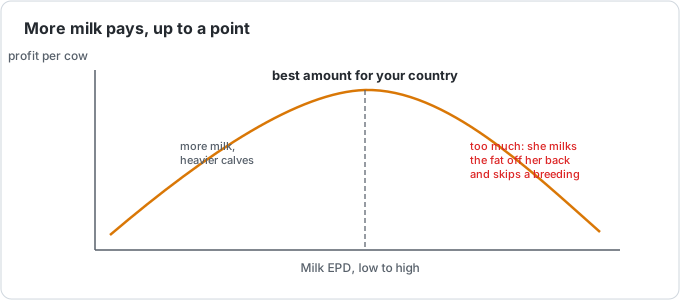
The Association built that fact right into the math. In the Maternal Weaned Calf Value index, the $M number, milk is not weighted in a straight line the way most traits are. $M uses a non-linear model for milk (angus.org). A straight line would say every added pound of milk is worth the same, on and on forever. The curve says something truer: added milk pays while the cow can still feed it, then flattens, then turns and costs you once she cannot. The model finds that turning point, the spot where more milk stops paying, and stops rewarding milk past it. A straight line cannot do that. A curve can, because the real trade-off is a curve.
That is the difference between reading the raw Milk column and reading $M. The raw column keeps rewarding milk with no ceiling. $M knows there is a ceiling and prices it in.
$EN is the cost side of the same coin
There is one more number that watches the bill milk runs up. It is the Cow Energy Value, the $EN number. Where $M weighs what the cow’s milk and pounds are worth, $EN counts what she costs to keep.
$EN is reported in dollars of feed-energy saving per cow per year, in the bull’s daughters (angus.org). It is driven by two things: how much milk his daughters make, and how big they get. Both cost feed every day of the year, in a wet year and a dry one. A higher $EN means a daughter who costs less to run, because she carries less milk and less mature size to feed.
Now you can see the pull. $M wants enough milk to wean a good calf. $EN wants less milk so the cow is cheaper to keep. They lean against each other on purpose, because that is the real decision on your place: enough milk to raise the calf, not so much that the cow eats her profit and skips a breeding. Read the two side by side and you are looking at both halves of the milk decision, the pounds it earns and the feed it burns.
What to carry from the fence
You do not compute any of these numbers, and neither do we. The American Angus Association runs the whole evaluation every week, across the entire breed, folding in DNA, and publishes the Milk number, $M, and $EN. A breeder’s job is to read them and match them to his own grass.
Carry three things. Milk is a bet on the bull’s daughters, not his calves, and it pays a generation late. It has a best amount set by what your country can feed, not by the top of the column. And the $M curve and the $EN cost together already do the balancing that staring at the raw Milk number never will.
Related: why you cannot push one number without moving another · what’s inside a dollar value · which dollar value fits your operation. Back to the reading guides.


Leave a Reply