
Say you decide growth is what you want. Bigger calves, more pounds to sell. So you go through the sale book and buy the highest yearling-weight bulls you can find, year after year, and you ignore the rest of the page.
It works, at first. Your calves do come bigger.
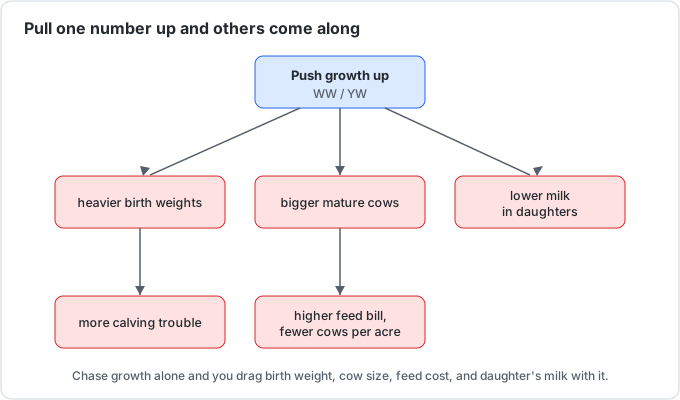
But something else creeps in that you did not order. Your cows come bigger too. A bigger cow eats more, every single day, in a wet year and a dry one. Your feed bill climbs. The pasture that used to run a hundred cows now runs ninety. And the cows that used to hold their flesh on grass alone now need help getting through winter.
You pushed one number. Three others moved on their own.
Traits travel together
Here is the thing nobody tells you when you first pick up a sale book. The traits are not separate dials you can turn one at a time. They are tied together. Pull on one and others come along for the ride, some the way you want and some the way you don’t.
This is not somebody’s opinion. It is how the animal is built. The same genes that make a calf grow fast also make him grow big, and a bull who sires fast-growing calves tends to sire bigger cows down the line. Darrh Bullock, an Extension specialist at the University of Kentucky, puts it plainly in his practical guide for using EPDs: higher growth usually brings heavier birth weights, more calving trouble, lower milking in the daughters, and a larger cow herd. His word for the answer is balancing. Not maxing. Balancing.
So chasing one number to the top of the breed is not a shortcut. It is a way to wreck three things you were not watching while you stared at the one.
Milk is the sharpest example
Take milk, because it fools more good cattlemen than any other trait.
The Milk EPD, short for Expected Progeny Difference, is the Association’s prediction for that trait, measured in pounds of the daughter’s weaned calf. It says how much extra weaning weight a bull’s daughters put on their calves through milk and mothering. Simple math on the surface: five pounds more Milk EPD in a bull means his daughters wean calves about five pounds heavier (Bullock). More milk, more pounds, more money. Who would not want that?
So a man reads the column and picks the highest-milk bull he can find, figuring he just bought himself heavier calves for free.
Here is what he did not buy: the feed to pay for it.
A heavy-milking cow is a hungry cow. Making all that milk takes groceries, far more than a moderate cow needs. In good country with feed to spare, she might get away with it. But in short-feed country, or in a dry year anywhere, she cannot eat enough to milk that hard and keep herself in shape too. So she does what a cow always does. She milks the condition right off her own back. She pours it into the calf and comes up thin.
And a thin cow does not breed back. Bullock names it directly: too much milk for the country burns the cow’s body condition down and drops her back into breeding, sometimes so far that a young cow fails to settle after her first calf. You weaned a slightly heavier calf and lost the cow’s next one. That is not a trade. That is a loss.
The best milk is the amount your country can feed
So how much milk is right? Not the most. The amount your grass can pay for.
That is the whole lesson, and it is worth saying slow. Milk is not an up is always better trait. It has a best amount, an optimum, and that amount is set by your country, not by the sale book. On lush ground you can carry more. On hard, dry ground you want less, because a moderate cow that breeds back every year beats a big-milking cow that skips a year. The right number is the one your place can feed without breaking the cow.
Many traits are roped to others this way. Push one to the far end of the column and you quietly pay for it on a trait you were not watching. Growth drags up cow size and the feed bill. Milk drags up the feed bill and the risk to the rebreed. The extreme end of a column is rarely the spot that fits your country.
This is exactly why the dollar indexes exist
Now you can see the corner a man paints himself into. You cannot fix this by staring harder at one column. Push growth and you move cow size and feed cost. Push milk and you move the feed bill and maybe the rebreed. Every column is roped to the others, and you have more columns than you can hold in your head at the fence.
Somebody has to weigh all those traits against each other, and price out the trade, and hand you one honest answer. That is the whole job of the dollar indexes, the $Values on the page. Each one takes a pile of EPDs, weighs each trait by how much money it actually moves, counts the cost of the bigger cow and the risk to the rebreed right alongside the pounds gained, and reports the result in dollars of profit per head. It does the balancing that no single column can do, and it does it with the trade-offs already built in.
You do not compute any of this, and neither do we. The American Angus Association runs the whole evaluation every week, across the entire breed, and publishes both the EPDs and the $Values. A breeder’s job is to read them well and match them to his own country.
That is the next piece. For now, carry this one: no trait moves alone, and the highest number in a column is almost never the right number for your country.
This is piece 3 of EPDs, Plain and Simple. For the mechanism behind all these numbers, read what EPDs really are.


Leave a Reply