
You have heard the gripe at the sale barn. A man’s bulls read high, and somebody leans over the rail and says, “Sure they do. Look how he feeds them.” Pour the groceries to a set of calves, weigh them heavy, and the good numbers follow. If that were true, an EPD would be nothing but a rich man’s feed bill dressed up as genetics.
It is not true. And the reason is one piece of plumbing built into the way these numbers are made. It is called the contemporary group. Once you see how it works, you will never again believe a feed truck can buy a bull a good number.
Same pen, same day, same everything
An EPD, remember, is a prediction about an animal’s future calves, written as a difference from another animal, not a measurement of the animal himself. To make that comparison fair, the American Angus Association does not weigh a calf against the whole breed at once. It first sorts calves into contemporary groups.
A contemporary group is a set of calves that were treated the same. Same sex. Same herd. Same birth season. Same feed and same management. Weighed on the same day, on the same scale. Each rule strips out one more thing that is not genetic. Bulls and heifers grow differently, so you do not mix them. An early calf has a head start on a late one, so you group by season. A pen fed hard is not the pen out on grass, so management has to match. What you are left with is a set of animals whose only real differences are the ones a scale cannot see: their genetics, and the luck of the draw. Everything they shared, the grass, the weather, the good year or the hard one, is held in common, so it can be set aside.
The evaluation subtracts the group, and only the gaps live
Here is the move that does the work. The evaluation treats each contemporary group as one shared environment and subtracts that environment back out. In plainer words, it takes each group’s own average off the top and keeps only how far each calf stood from his own herdmates. This is the National Cattle Evaluation the Association runs across the whole breed.
Do that, and the feed disappears.
Picture two herds. The first is fed hard and weans three bull calves at 700, 750, and 800 pounds. The second runs tough country and weans three at 500, 550, and 600. On the scale they look like different worlds, a full 200 pounds apart. But subtract each herd’s own average and both herds tell the exact same story. One calf fifty pounds under, one dead on the average, one fifty over. Minus fifty, zero, plus fifty, in both pens. The extra 200 pounds of feed in the first herd said nothing about genetics. It lifted all three calves together and washed straight out in the subtraction.
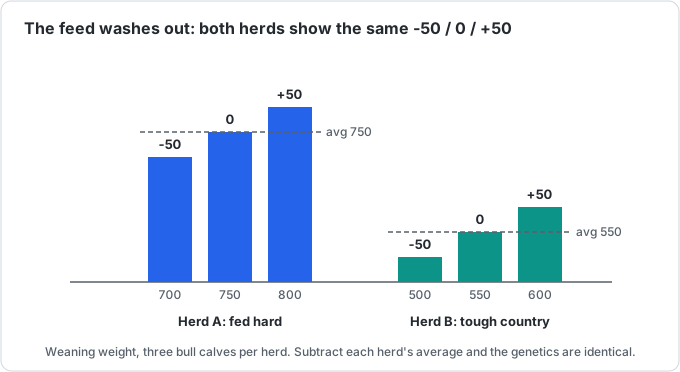
That is the whole thesis. Anything you do to the whole group, more feed, better grass, a growth implant, an easy year, helps every calf the same and cancels. Only the gaps between calves raised side by side survive, and a gap is the one thing feed and bragging cannot manufacture.
Why the gaps have to add up to zero
Look again at those two lists. Minus fifty, zero, plus fifty. Add them up and you get zero, in both herds. That is not a coincidence. It is forced.
When you measure every calf against his own group’s average, the ones above and the ones below have to balance. That is what an average is. So inside any group there is always a top, a middle, and a bottom. You cannot have all your calves above their own average, any more than every calf in the pen can stand taller than the pen’s average height. “They’re all my best ones” cannot be true of a whole group, and the math will not let the seller pretend otherwise.
You do not own the ruler: connectedness
There is a bigger door, and it is the part the two-herds story alone does not show you. It is called connectedness.
Your calves are not scored on your ruler. They are placed on one breed-wide scale, and your herd is tied to thousands of others through the bulls everybody shares. Artificial insemination, breeding your cows to a shared bull by shipped-in semen instead of a bull in your own pasture, means one popular sire drops calves in your pen and in a hundred other pens across the country. Those shared sires are the stitches that sew all the separate herds into one fabric. Without them, no honest comparison across herds would be possible.
That is what catches a bull who only shines at home. Say your young herd sire lights up your pen. His calves top every group you own. But his half brothers, sired the same way, are calving out ordinary in twenty other herds on other feed and other grass. The evaluation sees all of it at once and settles the bull where the whole body of evidence puts him, not where your feed and your fondness put him. A number that is only local gets found out.
Report the whole group, top to bottom
Connectedness also explains why you turn in the whole group, not just the calves you are proud of.
Say you cull the poorest calves before weigh day and report only the good ones. It feels like it should help. It does the opposite. Drop the bottom out of a group and you raise the group’s average, and now your good calf is measured against a stiffer bar. He comes out just average among the calves you kept. The honest move and the winning move are the same one: weigh them all, report them all. And a single calf reported alone, with no herdmates to stand against, tells the evaluation almost nothing.
The honest caveat
None of this makes cheating flat impossible. A man can still falsify a weight or fudge a birth date to slip a calf into a softer group. That is fraud, and fraud happens.
But look at what the structure does to it. It makes the quiet, everyday kind of number-padding, the feed-truck kind, completely pointless, because it cancels in the subtraction. And it makes the outright lies fragile, because a faked calf still has to go perform in everybody else’s pens through those shared sires. Over enough herds and enough years, the genetics either show up across the breed or they do not.
So a herd truly can run above breed average. Deluisio Angus, or any honest herd, can carry cattle that read high and back it up. But the way you get there is by having the genetics, not by feeding heavier or talking louder. Dr. Darrh Bullock lays the same idea out plainly in his Practical Guide for Using EPDs: fair comparison comes from animals raised and managed alike, which is exactly what a contemporary group is.
What to carry from this
You do not compute any of this, and neither do we. The American Angus Association runs the whole evaluation every week, across the entire breed, sorting calves into contemporary groups and settling every animal on one scale. A breeder’s job is to read the result well and bring the cow sense a number was never built to hold.
So when you see a bull’s number, you are not looking at his feed bill. You are looking at how he and his kin stacked up against their own herdmates, pen after pen, across the whole country. That is why a third-party number beats a seller’s word. The feed truck was already subtracted out.
Related reading: the fuller story of how these numbers are made is in what EPDs really are. For how traits pull against each other once you trust the numbers, see how EPD traits pull against each other. Back to the reading guides.


Leave a Reply