You are leaning on the rail at a bull sale. Two bulls in the catalog both read +90 for the same weaning weight trait. On paper they are twins. But one is a proven herd sire with a hundred calves on the ground, and the other is a yearling with nothing behind him yet but his sire and his dam.
Your gut says those two +90s are not the same bet. Your gut is right. This piece is about why, and about the one number on the page that tells you.
First, the line this whole thing rests on. No breeder computes these numbers, not us and not anyone. The American Angus Association runs them across the whole breed every week. What follows is how to read what they publish, not a claim that we make it.
An EPD is really a range, not a point
Start with the word. An EPD, an Expected Progeny Difference, is a forecast of how an animal’s future calves will compare against another animal’s. It is a difference, measured on a fair scale, not a weight you put on the animal itself.
Here is the part most people miss. That +90 is the middle of a range, not a hard number. The real thing behind an EPD is a band: the best guess, plus or minus some amount on either side. The Angus Association has a name for that amount. They call it possible change, “a measure of expected change or potential deviation between the EPD and the ‘true’ progeny difference” (American Angus Association, Accuracy and Possible Change). It is the width of the band around the guess.
And there is a second number on the page that tells you how wide the band is. That is accuracy. The Association defines it as “the reliability that can be placed on the EPD. An accuracy of close to 1.0 indicates higher reliability” (American Angus Association, Accuracy and Possible Change). Accuracy runs from 0 to 1. The higher it is, the smaller the possible change, and the narrower the band.
So the two numbers work together. The EPD is the best guess. Accuracy tells you how much to trust it, by setting how wide the band of possible change is around it. A high-accuracy number is a tight band. A low-accuracy number is a wide one.
What “two-thirds of the time” means
The Association puts a plain rule on the band. For a given accuracy, “about two-thirds of the time an animal should have a ‘true’ progeny difference within the range of the EPD plus or minus the possible change value” (American Angus Association, Accuracy and Possible Change).
Read that slowly. The true answer, the thing the bull would really pass on if you bred him to a hundred cows, sits inside the band about two times out of three. Not always. Most of the time.
Here is their own worked example, so you can see the band with real numbers. Take a sire with an accuracy of .60 for a marbling EPD of +0.50. His possible change works out to plus or minus .12 of a marbling score. So his true progeny value is expected to fall between +0.38 and +0.62, about two-thirds of the time (American Angus Association, Accuracy and Possible Change).
That is the whole idea in one line. The number on the page is +0.50. The truth behind it is “somewhere around +0.38 to +0.62, most likely.” The single number was hiding a range the whole time.
Why two big numbers can be the same bet
Now go back to your two bulls at the rail, both reading +90.
The proven bull has a hundred calves behind him. His accuracy is high, so his band of possible change is narrow. His +90 is a tight guess. The truth is close to +90, give or take a little.
The yearling has only his parents behind him. His accuracy is low, so his band is wide. His +90 could sit well above +90 or well below it. The guess is honest, but it is soft.
This is where it bites. When the band is wide enough, the yearling’s range can stretch down past where the proven bull’s range sits. The two ranges overlap. And once they overlap, you cannot say the higher number is really the higher bull. The soft +90 might really be an 80 wearing a 90’s clothes. The proven +90 might edge it out even though the page says they tie.
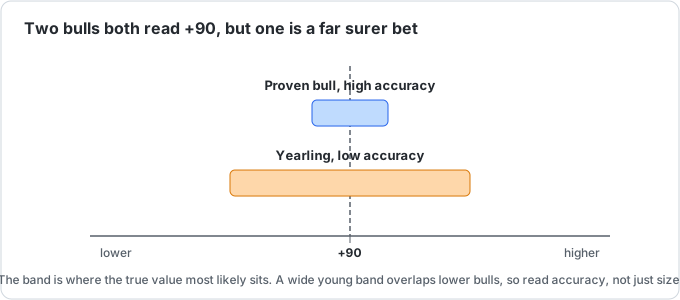
That is the key thing to carry out of here. Two low-accuracy numbers that overlap are not a ranking. The bigger one is not reliably bigger. It only looks bigger because you are reading the middle of the band and ignoring the width.
So you do not read size alone. You read size and accuracy together. A slightly smaller number with a tight band can be the safer, and sometimes the better, animal than a slightly larger number with a band you could drive a truck through. When the numbers are close and the accuracies are far apart, the accuracy is telling you which “close” is real.
A young number is meant to move
None of this means the yearling’s number is wrong. It is doing exactly what it should. A low-accuracy number is a wide band because there is not much behind it yet. As his own calves hit the ground and get weighed against their herdmates, the band tightens and the number settles toward the truth. A number that moves is the system working, not failing.
There is one tool that tightens the band early, before a single calf is born. That is genomics, a DNA test read off a cheek swab or a blood card. The Association folds that DNA into the same weekly evaluation through what it calls single-step, so a tested yearling can carry more accuracy, and a narrower band, than his age alone would earn (American Angus Association, angus.org/agi). It does not make a young animal proven. It just narrows the guess sooner. You may also see an “I” in front of a young animal’s number for interim, meaning his own records are not fully folded in yet.
A note on the old service-record folder image, if you have met it. That folder is a fine way to picture where accuracy comes from: the more records behind a number, the more you trust it. But trust is not the whole story. The band of possible change is. Two bulls can each have a thick folder and still read numbers that overlap, and it is the width of the band, not the size of the folder, that tells you whether the higher number is really higher.
What to do with it Monday
At the rail, do three things.
Read the EPD and its accuracy in the same glance. Never one without the other.
When two numbers are close, let accuracy break the tie. The tight band beats the wide one when the middles are near each other.
And treat a wide band on a young bull as a spread bet, not a sure thing. If you are buying young and unproven, buy more than one, so the ones that settle high cover the ones that settle low.
The number still narrows the field. The stockman still decides at the fence, on feet and legs and fit to your grass, which the number never sees. Read for the band, not just the middle, and the page stops fooling you.
Related reading: What an EPD is for where accuracy first comes up, and What counts as a good number for judging a number once you have it. Back to the reading guides.


Leave a Reply