You have seen these in a sale catalog. A dollar sign, a couple of letters, and a number. $M 72. $W 58. $C 210. They sit next to the EPDs and they look like a score, like the bull got graded.
They are not a grade. They are a total. And once you see what got totaled up, you can read one out loud to your neighbor and be right.
Start with what you already do
Say you are pricing a used truck. You do not weigh every part the same. Good tires bump the price a little. A rebuilt engine bumps it a lot. High miles pull it down. Rust pulls it down. You run all of that through your head and land on one number: what the truck is worth to you.
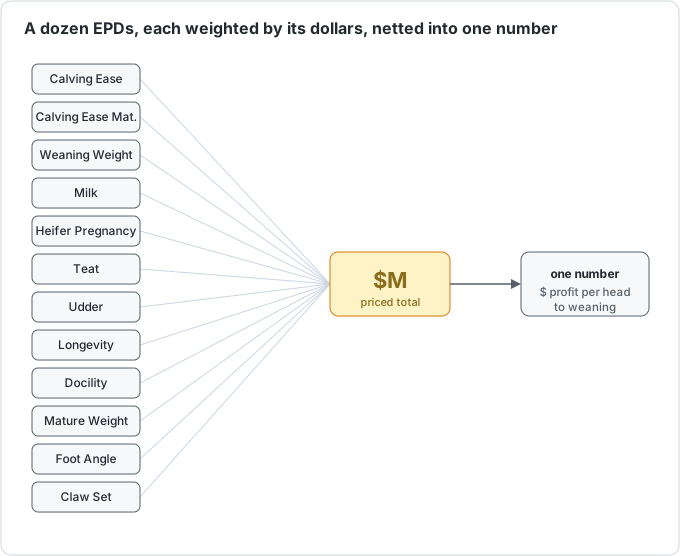
A $Value does the same job for a bull’s genetics. It takes a whole handful of separate EPDs, counts each one by how much money it makes or costs, and nets them into a single number. That number is dollars of profit per head.
Remember what an EPD is: a prediction, written as a difference, of how one animal’s calves will perform against another’s. (The first piece in this series walks through it.) A $Value bundles many of those predictions together and prices them out.
One number, in dollars
Here is the plain reading, and it is the one to carry to the counter.
Take two bulls. One has a $M of 72, the other a $M of 60. That is a difference of 12. So you would expect the higher bull’s calves to average about $12 more profit per head, under the way that index keeps its books. Twelve dollars a calf. Across a calf crop, that adds up.
That is the rule for every dollar index: the gap between two bulls is roughly the dollars of profit per head you would expect between their calves (Bullock, Practical Guide for Using EPDs). Same as an EPD, a $Value is a difference, not a promise about any one calf. It tells you where the calves cluster, not what the next one brings.
The recipe inside $M
A $Value is only as clear as its ingredient list, so here is a real one. $M stands for Maternal Weaned Calf Value. It predicts profit per head from conception to weaning for a man who keeps his own replacement heifers. The American Angus Association ($Value definitions) builds it out of these EPDs:
- Calving Ease Direct and Calving Ease Maternal (calves born alive and unassisted, now and in the daughters)
- Weaning Weight and Milk (pounds on the calf, some from the calf, some from the cow’s milk)
- Heifer Pregnancy (do the young females breed)
- Teat and Udder scores (does the cow’s bag hold up)
- Functional Longevity (how many years the daughters stay productive in the herd)
- Foot angle and Claw set (does she stay sound underneath)
- Docility (is she quiet to handle)
- Mature Weight (how big, and so how costly, the cow gets)
Look at that list and you can see the goal it is chasing: a moderate cow that breeds back, feeds her calf, stays sound, and does not eat you out of house and home. Each of these traits gets counted by its own dollar weight, some adding, some subtracting, and the net lands in that one $M number. You do not do the arithmetic. The index already did it.
For what each of these traits means on its own, see our guide to the traits.
A $Value has a vintage
Now the part most people miss, and the one that keeps you honest.
A $Value is two things stacked together. The first is a genetic prediction, the same honest forecast as any EPD. The second is a set of price assumptions: what a weaned calf brings, what a bred heifer is worth, what feed costs to put a pound on a cow. You cannot turn genetics into dollars without deciding what a dollar buys.
Those prices are refreshed once a year against a rolling market average. So a $Value has a vintage, the way a truck has a model year. The genetics in it can be dead on while the price tags behind it have drifted from what your market is paying this fall. That does not make the number junk. It makes it a number with a date on it, and worth reading as one.
Nobody at the ranch computes this
One last thing, because it is where the trust comes from. No breeder computes these $Values, not us and not anyone. The math runs at the American Angus Association, in its national evaluation, across the whole breed. A ranch could not hold that much data or run that evaluation across the whole breed every week. What a breeder does is read the number well, know which index he is reading, and pair it with what the number cannot see: this cow’s feet, this year’s grass, this buyer’s tastes.
So when you see $M 72 in a catalog, you are not looking at a grade the bull earned. You are looking at a priced-out total, figured off the ranch, with a date on it. Read it as one.
This is piece 4 of EPDs, Plain and Simple. Piece 5 asks which $Value fits your operation. For the fuller picture of how EPDs and indexes work together, see what EPDs really are.


Leave a Reply