
You are standing at the sale barn counter with a bull’s page in your hand. His weaning weight EPD reads +80. Somebody asks you if that is any good, and you realize you have no honest answer, because a number by itself has no yardstick.
Think of a kid coming home from school saying he scored a 50. Good or bad? You cannot tell yet. Fifty out of what? And where did the rest of the class land? A bare number means nothing until you know two things: what it is counted from, and where it sits in the crowd. Reading an EPD is the same job. This piece hands you both yardsticks.
If you are new to what an EPD even is, start with What an EPD Is, in Plain English. This one is about judging one once you have it.
Zero is a flag in the ground, not average
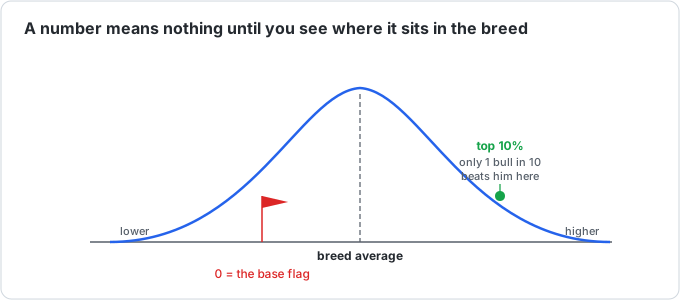
Every EPD is a distance from a starting point. That starting point is called the genetic base. Picture a flag the American Angus Association planted in the ground back on a set date. Zero is that flag. Every bull’s EPD tells you how far his expected calves land from it.
Here is the part people get wrong. Zero does not mean average, and it does not mean nothing. It is just the spot the ruler starts from. The breed has kept improving since that flag went in, so on the traits breeders have pushed on, like growth, most Angus today sit well on one side of the flag. A bull at zero on those traits is not a middle-of-the-road bull anymore. He is behind the bulk of the breed, because the pack moved on past the flag years ago.
So the raw EPD, that +80, tells you the distance from the flag. Useful, but it still does not tell you where +80 puts you against the bulls selling today. For that you need the second yardstick.
Percentile rank tells you where he sits in the crowd
Percentile rank answers the real question: out of all the Angus in the book, how many are better and how many are worse? Top 10% means only one bull in ten beats him on that trait. Top 1% means one in a hundred. That is the number that actually sizes him up.
Reading it is simple, and the Association does the heavy lifting. It publishes a percentile chart for each trait. To find where your bull ranks:
- Pick the chart that matches the kind of animal you are judging. The Association posts more than one, split by the kind of animal, so start on the right page.
- Find the trait’s column, like weaning weight.
- Run down it until you reach his EPD, +80.
- Read across to the percentile beside it. That is his rank.
That is it. No math, no statistics class. You are looking up his number on a chart somebody already built, the same way you would look up a truck’s trade-in value in a price guide. This is the method Darrh Bullock lays out in his practical guide for using EPDs.
Breed average is the middle of the pack
The same page gives you the breed average: where the middle of the current population sits for each trait. That is your “ahead or behind” line. Above the average on a trait where higher is better, he beats the typical Angus. Below it, he trails. The average is a better yardstick than the zero flag, because the average is the breed as it stands right now, not as it stood when the flag went in.
One caution the chart cannot say out loud: higher is not always the goal. On some traits, like birth weight, you want a lower number. On others, like milk, there is a best amount for your country, not a “more is always better.” So read the percentile to learn where he ranks, but settle which direction you actually want first.
The numbers move, so do not memorize them
Here is the thing that trips up good cattlemen. These charts are not carved in stone. The Association re-runs its evaluation every week and re-publishes the breed averages and percentiles as the whole breed shifts. What counts as top 10% this year will take a higher EPD to reach a few years from now, because the breed keeps climbing.
That is why a +50 today does not mean what a +50 meant when your father was buying bulls. Same number, different rank, because the pack moved under it. So do not memorize a rule like “top 10% takes such-and-such an EPD” and carry it around for years. Pick any pairing you please; it goes stale. Instead, pull up the live chart the day you are judging a bull, and read his rank off the current page.
Remember, too, that no breeder makes these charts. The Association builds them from the whole breed’s records, every week. Your job is to read them well.
Do that, and you will never again get stuck at the counter with a number and no yardstick. You will know exactly what a +80 means: not the size of it, but where it stands in the breed the day you are buying.
This is piece 2 of EPDs, Plain and Simple. For the deeper story on where these numbers come from and why the calf is never exactly the paper, see what EPDs really are.