Two of the best-looking cattle you own can throw a calf that never stands.
The bull is sound. The cow is sound. Neither one ever showed you a thing wrong. Then their calf comes weak, or crooked, or dead, and you are standing in the lot trying to figure out what you did. Most times the answer is nothing you could see. You paired two carriers of the same hidden fault, and the odds finally came due.
This is the one part of the numbers where a little bit of understanding saves you a lot of grief. The good news is the rule is simple, and once you have it you can stop guessing.
What a recessive is
A recessive is a fault that only shows up when a calf gets two copies of it, one from each parent. One copy alone does nothing you can see.
An animal with one copy is called a carrier. A carrier looks completely normal. It grows normal, breeds normal, and lives a full life. You cannot pick it out of the pen, and you cannot pick it out by pedigree alone. The only way to know is a DNA test.
That is the whole trap. The fault hides in healthy animals for generations. It costs you nothing until the day two carriers of the same fault meet in a mating.
The one rule that matters
Only two carriers of the same condition are the danger. Everything else is safe.
Here is what a carrier-to-carrier mating does, for each calf:
- 25 percent chance the calf is affected, meaning it got both copies and shows the fault.
- 50 percent chance the calf is a carrier like its parents, normal to look at.
- 25 percent chance the calf is clear, carrying none of it.
Those are the odds on every single calf, not a count across the calf crop. Breed the same pair five years running and each calf is its own coin flip at those same odds. You could get unlucky twice or lucky for a while. The odds do not remember.
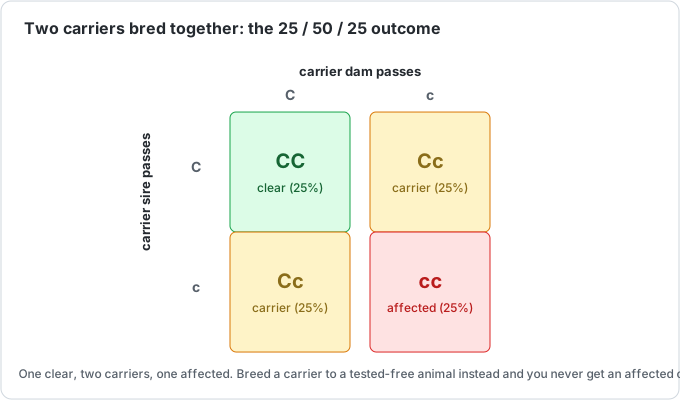
Now the part that turns this from a worry into a plan. Breed a carrier to a tested-free animal and you will never get an affected calf. Not one. Half the calves may still carry the fault, hidden, but none can be affected, because an affected calf needs two copies and the free parent has none to give.
So the whole strategy is one line: do not pair two carriers of the same condition. You do not have to purge carriers from your herd. A carrier bred to clear mates is a normal, productive animal that never throws you an affected calf. Culling every carrier would throw away good cattle for no reason. You just have to know which is which before you double up.
The status codes you will see
The American Angus Association tests for these conditions and reports each animal’s status with a letter. You read the letter. You do not compute it, and neither does any breeder. The test is a lab result on that animal’s DNA.
- F, free. Tested and carries no copy. Safe to breed to anything for that condition.
- C, carrier. Tested and carries one copy. Normal animal, but do not breed it to another carrier of the same condition.
- A, affected. Carries two copies. Rare, since most affected calves do not make it.
- P, potential carrier. Not tested itself, but traces back to a known carrier through untested ancestors. Treat a P like a C until a test clears it, because it might be carrying.
There is also a way an animal earns clear status without a direct test on itself. When an animal has produced a large number of calves through its daughters with the fault never once surfacing, the Association can designate it Recessive Trait Free by descent. That is a clean record proving the fault is not there to pass on.
The conditions the Association recognizes
These are the simple-recessive conditions the Association currently tests for and reports, each known by a short code:
- AM, Arthrogryposis Multiplex
- NH, Neuropathic Hydrocephalus
- CA, Contractural Arachnodactyly
- DD, Developmental Duplication
- OS, Osteopetrosis
- M1, the nt821 double-muscling mutation
- OH, Oculocutaneous Hypopigmentation
- D2, the PRKG2 dwarfism mutation
You do not need to memorize what each one does to the calf. What you need is the code and the status next to it on the animal’s record. The rule is the same for all of them: a carrier is safe on a free mate, and two carriers of the same code are the pairing to avoid.
I am not going to hand you a made-up number for how common any of these are in the breed. Those frequencies come from the Association’s testing data, and they change. What does not change is the rule you use at mating time.
What you actually do at the pen
You do not have to become a geneticist. You have to do one check before a mating.
Look at the bull’s status for each condition. Look at the female’s. If both come up C for the same condition, or one is C and the other is P for that same condition, that is the pairing to fix, either by picking a different mate or by testing the P animal to see if it is actually clear. If either side is F for that condition, you are safe on it. Different conditions on the two animals do not combine, so a carrier of AM bred to a carrier of NH cannot make an affected calf. It is only the same fault meeting itself that hurts you.
That is the entire job. Read two letters, and do not let two of the same C meet.
Where this sits in the bigger picture
The line here is the same line that runs through everything in these guides. The Association runs the DNA tests and reports the statuses. Deluisio Angus reads those statuses and screens matings against them. A carrier code is a lab result on an animal, not a number anybody on the ranch cooks up. The methodology spells out how a mating screen flags a carrier-by-carrier pairing so it can be caught before the calf is on the ground, not after.
For the full list of conditions, the current test panel, and the Association’s reporting policy, go straight to the source: the Association’s genetic conditions program. It tests, it reports, and it does not force you to cull. It assumes you will read the status and breed accordingly, which is exactly what the one rule lets you do.
Related reading: Understanding Angus Genetic Selection for how conditions sit alongside the EPDs, and Reading Inbreeding Coefficients, since tight matings are also where a hidden recessive is most likely to surface. Back to the reading guides.


Leave a Reply