
The sale book landed in your mailbox this week. A hundred bulls in it, maybe more. The sale starts at one o’clock Monday, and your coffee is already cold. You cannot lay eyes on a hundred bulls, and you cannot study a hundred rows of numbers. You need to walk in with a short list, not the whole book.
Here is the trap most men fall into. They open the book and read it like a scorecard, running an eye down the page and circling whatever number is biggest. That is how you end up bidding on the wrong bull with real confidence.
There is a better way, and it is a routine, not a talent. You winnow. You start with the whole book and make a few passes, and each pass throws out the bulls that do not fit, until the stack is small enough to walk the pens and finish with your eye. The other guides in this library each teach one of these passes. This one puts them in order, so Monday morning has a plan.
Five steps. The first four happen at the kitchen table before you ever load the truck. The last one happens at the pen.
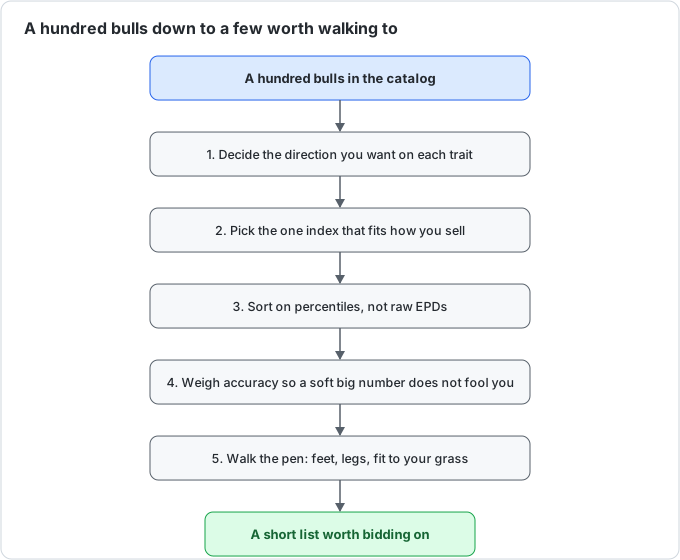
Step one: decide which way you want each trait, before you open the book
Do this first, and do it away from the book, so no bull’s big number talks you into wanting something you do not need.
Go trait by trait and settle one thing for each: which direction is right for your outfit. On most growth traits, higher is the goal. On some, it is not. You want a lower birth weight number on heifer bulls. You want a lower number, not a higher one, on claw set and foot angle. And on milk there is no “more is always better,” there is a best amount for the country you run, because a cow that milks harder than your grass can feed will milk the fat off her own back and skip a breeding.
You do not have to hold all of that in your head. The field guide, every number on the bull page, lays out each trait in one line: what it means, which way you want it, and the catch. Read it once, decide your directions, and write them down. That written list is your filter. It turns the book from a wall of numbers into a set of yes-or-no questions.
Step two: pick the one index that matches how you make money
The sale book has a row of dollar figures after each bull: $M, $W, $F, $G, $B, $C, and the rest. Do not shop all of them. Pick one.
Each of those indexes was built for one way of running cattle. $M is built around a cow that stays in the herd and raises calves. $B is built around calves you feed out and sell on the rail. If you sell calves at weaning and keep your own heifers, the terminal carcass indexes were built for somebody else, and the biggest $B in the book is worth nothing to you. So the question is never “which dollar number is highest.” It is “which index was built for a man who makes money the way I do.”
The piece which $Value fits your operation walks you to your index. Pick it, then read only that column. Bullock, in the University of Kentucky guide to using EPDs, puts it plainly: the well-suited index is the one with the least risk of a poor pick. Not the biggest. The suited one.
Step three: sort on percentiles, not raw EPDs
Now you have your index and your directions. Time to rank the bulls. But do not rank them on the raw EPDs.
A raw EPD is a distance from a starting flag, and by itself it has no yardstick. A weaning weight of +80 could be near the top of the breed or near the middle, and the number alone will not tell you which. What tells you is the percentile: out of all the Angus in the book, how many bulls beat him on that trait. Top 10 percent means one bull in ten is better. That is the number that sizes him up.
You do not compute that. The American Angus Association publishes a percentile chart for each trait, and it re-runs the whole thing every week, so a rank you memorized last year is already stale. Pull the live chart the day of the sale, find the bull’s number in the trait column, and read his rank beside it. Sort your stack by rank, not by the raw figure. The piece what counts as a good number shows exactly how.
Step four: weigh accuracy, so a soft big number does not fool you
You have a ranked stack now. Before you trust the top of it, check the accuracy on each bull, the number that runs from 0 to 1 beside his EPDs.
Here is why it matters. An EPD is really a range, not a hard number. A high-accuracy bull has a tight range around his figure. A young, unproven bull has a wide one. So two bulls can both read +90, and the proven bull’s +90 is close to the truth while the yearling’s +90 could really be an 80 wearing a 90’s clothes. When the ranges overlap, the bigger number is not reliably the bigger bull.
So do not let a soft big number from a young bull crowd out a proven bull whose number is a hair lower but rock solid. And if you do buy young and unproven, because those bulls carry the newest genetics, buy more than one, so the ones that settle high cover the ones that settle low. The piece accuracy and the range behind it is the full story. Genomic testing tightens a young bull’s range early, before he has a calf on the ground, but it does not make him proven.
Step five: the eye decides at the pen
Now your short list is small, a handful of bulls that point the right way, rank high in the index that fits you, and carry numbers you can trust. The numbers have done their job. They took a hundred bulls down to a few worth walking to.
The last cut is yours, and no number makes it for you. Walk the pens. Look at feet and legs, because a bull that cannot travel will not cover cows no matter what his page says. Look at how he is built and whether he fits your country. The EPD never saw his feet, never saw your grass, and never will. That is not a weakness in the numbers. It is the reason the man at the fence still matters.
The one thing to carry to the counter
You never computed a single one of these numbers, and neither did the seller. The Association runs the whole evaluation breed-wide, every week, and prints the results. Your job Monday is not to compute. It is to read, in order: direction, index, rank, accuracy, then the animal. The sale book’s own EPD legend, the insert the Association builds for sale books, tells you which column is which so you can run the passes fast. Do it that way and you walk in with a short list you can defend, instead of a circled number you cannot.
Related reading: every number on the bull page for the direction on each trait, which $Value fits your operation for picking your index, what counts as a good number for reading percentiles, and accuracy and the range behind it for weighing a soft number. Back to the reading guides.


Leave a Reply