
You have a bull picked out and a cow in mind. Before you ever turn them out together, you want to know what the calf will be, on paper. Not the color, not the look. The numbers. If the bull’s calves wean heavy and the cow comes from an easy-calving line, what should their calf be expected to do?
There is a way to figure that ahead of time, and it is simpler than most people guess. This piece walks through it, trait by trait, and then it is honest about what the figure can and cannot promise you.
The mid-parent: average the two parents, one trait at a time
An EPD, an Expected Progeny Difference, is a forecast of what an animal is expected to hand down to its calves. Each parent passes a random half of its genes to a calf. So the best first guess for the calf is the average of the two parents’ EPDs, done separately for each trait.
That is it. Add the sire’s number and the dam’s number, divide by two. Then do the same for the next trait. Cattlemen call this the parent average, or the mid-parent.
Here is a worked set. These are made-up animals, not real ones, put here only to show the arithmetic.
| Trait | Sire EPD | Dam EPD | Expected calf (mid-parent) |
|---|---|---|---|
| Birth weight (BW) | +2.0 | +1.0 | +1.5 |
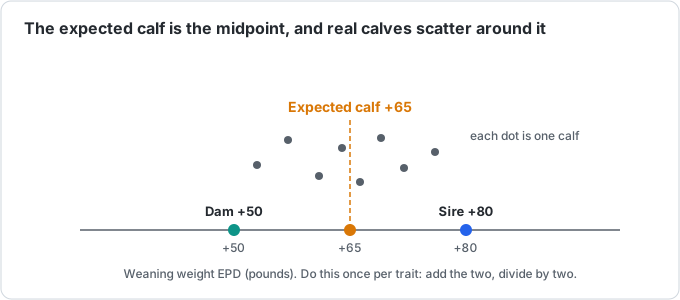
| Weaning weight (WW) | +80 | +50 | +65 |
| Yearling weight (YW) | +140 | +90 | +115 |
| Milk | +30 | +20 | +25 |
| Marbling (Marb) | +0.60 | +0.40 | +0.50 |
Every row is the same move: two numbers, halved. Nothing fancier is going on, and you never mix traits together. Birth weight is figured off birth weight, milk off milk.
Why the midpoint, and not something else
Why is the average the right guess and not, say, the better of the two parents?
Because an EPD is built around the half an animal transmits, not the whole animal. The sire hands the calf a random half of his genes. The dam hands over a random half of hers. The calf’s own expected transmitting ability is those two halves put together, which averages out to the midpoint between the parents. The calf is expected to sit halfway between what its sire transmits and what its dam transmits. That is the whole reason the mid-parent is the center of the guess.
This is not homemade math: it is the Association’s interim EPD
Here is the part that should raise your confidence in the mid-parent. It is not a shortcut somebody invented at the sale barn. It is exactly what the American Angus Association itself uses for a calf too young to have a record of its own.
When a young calf has no performance data yet, and both its parents carry real EPDs, the Association publishes an interim EPD, shown with an “I” in front of it. That interim number is literally the average of the two parents’ EPDs, carried at very low accuracy, around 0.05. So the mid-parent you figured on paper is the same number the Association would post as the calf’s first, provisional EPD. You are not guessing against the system. You are computing the system’s own first guess.
A note on the dollar indexes
You can do the same averaging with the $Value indexes, the dollar figures like $M and $B that bundle several traits into one number. Average the sire’s $M and the dam’s $M for a rough expected $M on the calf, and it will be close.
But be careful, because some indexes are not a straight line. $M, the maternal weaned calf index, runs milk through a curve, since past a point more milk costs more than it returns. When a trait is priced on a curve like that, averaging the finished index numbers is only an approximation. The exact way is to average the underlying trait EPDs first, then re-run the index on those averaged inputs. For comparing one candidate mating against another, the simple average of the parents’ $Values is close enough. When you want the precise expected index, average the parts and re-run.
The expected inbreeding is a different kind of average
Trait expectations come from averaging EPDs. The calf’s expected inbreeding comes from the pedigree instead, and it is figured a different way.
The inbreeding coefficient, or COI, of the calf is the coancestry of the two parents: how related the sire and dam already are, divided by two. This is a pedigree calculation, worked out long before EPDs existed, and it is the one genetic-flavored number a breeder legitimately computes rather than reads off a bull page. The companion guide on managing inbreeding covers it in full.
The repository ships this calculation. Give the inbreeding tool a proposed sire and dam and it returns the COI the future calf would carry:
inbreeding-coi examples/sample_pedigree.csv --sire C202 --dam C203
Inbreeding coefficient (COI) for C202 x C203 (projected calf): 0.15625
That 0.15625 is the exact inbreeding this mating’s calf would show, read straight off the pedigree, before the calf exists. (C202 and C203 are synthetic animals in a sample file, not real cattle.) So a proposed mating gives you two expectations at once: the trait numbers from averaging EPDs, and the inbreeding from the pedigree.
The catch: the midpoint is the center of a scatter
Now the honest part, and it matters more than the arithmetic.
The mid-parent is the center of a spread, not a promise. Real calves land around it, not on it. Each calf draws its own random half of each parent’s genes, so no single calf inherits the exact average. This is called Mendelian sampling, and you have watched it your whole life without the name: two full brothers out of the same bull and cow who turned out nothing alike. One drew a strong hand, the next a plainer one. The paper prints the middle of the scatter. The calf is one draw from it.
And a second caution. Your mid-parent figure is an expectation, not a real EPD. Once the calf is born, weighed, and enters the Association’s weekly evaluation, its published number moves off the parent average, for two reasons. Its own performance and genomics enter the math, and the Mendelian draw it actually got pulls it away from the midpoint. The interim number was always a placeholder waiting to be replaced.
So use the parent average for what it is good at: ranking candidate matings against each other before you breed. This bull on that cow versus this other bull on the same cow. It sorts the choices honestly. What it will not do is stamp a finished genetic value on an animal. Never treat a mid-parent as a real EPD.
Where the line sits
One last thing, because it keeps the whole picture honest. No breeder computes EPDs, not us and not anyone. They come out of the American Angus Association’s national evaluation, run across the whole breed every week, on more data than any ranch could hold. The parent average is the single legitimately EPD-flavored figure a breeder gets to estimate at the fence, and even that is an expectation, not a published number. Figure the mating on paper to sort your choices. Then let the evaluation do what only it can do once the calf is on the ground.
Related: What an EPD is · The bull that looked great on paper · Planning matings to manage inbreeding · How a modern operation uses the numbers · All the reading guides · Methodology


